
NextGen Aerodynamics: How MultiPhysics CFD is Accelerating UAV and Aircraft Design
Highfidelity numerical simulation is replacing physical wind tunnel testing, enabling aerospace engineers to validate complex flight dynamics and structural integrity virtually before manufacturing begins.
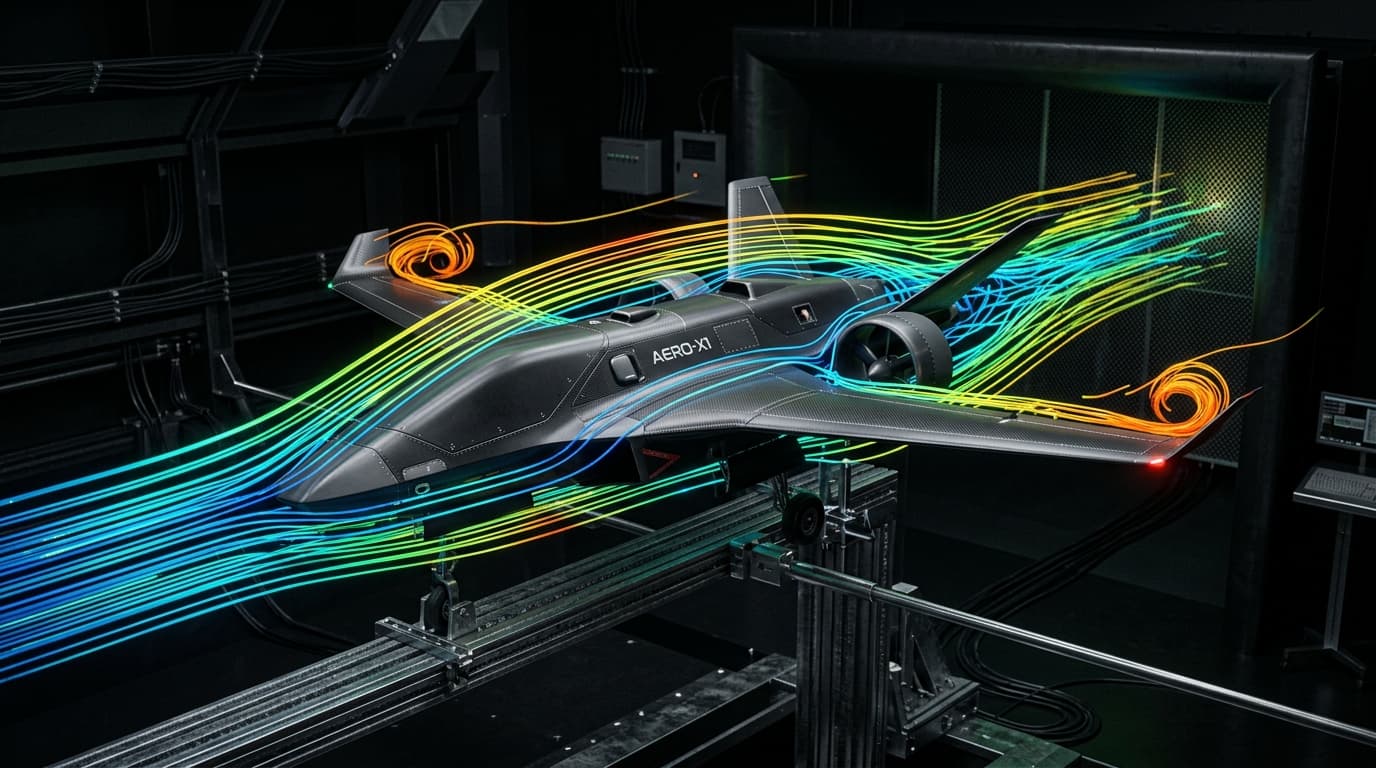
The aerospace industry is undergoing a quiet revolution. For decades, taking a new aircraft design or Unmanned Aerial Vehicle (UAV) from concept to maiden flight meant sinking millions of dollars and countless months into physical wind tunnel testing and iterative trialanderror prototyping. Today, digital engineering has shifted the baseline. Highfidelity numerical simulation, specifically multiphysics Computational Fluid Dynamics (CFD), allows engineering teams to validate flight performance virtually, changing how modern aircraft and drones are conceptualized, optimized, and built.
At Wafi Engineering's Aerospace Division, we harness these advanced simulation frameworks to help manufacturers build smarter, lighter, and more aerodynamic flight systems faster than ever before.
THE INDUSTRY SHIFT: FROM PHYSICAL WIND TUNNELS TO VIRTUAL PROTOTYPING
Traditionally, wind tunnel testing was the gold standard for aerodynamic validation. However, physical testing comes with inherent limitations: it is expensive, restricted by physical scale, time consuming to reconfigure, and often limited in the sheer volume of data it can capture simultaneously.
The modern aerospace landscape demands agility. With the explosive growth of commercial drone applications, urban air mobility (UAM), and next generation defense tech, development cycles have compressed dramatically. Transitioning to high fidelity numerical simulation in the early stages of design enables engineers to visualize flow fields, pressure distributions, and thermal gradients across entire geometries instantly. Instead of building five physical prototypes to test minor wing twist adjustments, computational modeling evaluates dozens of iterations overnight, drastically slashing research and development overhead.
THE ENGINEERING CHALLENGE: NAVIGATING COMPLEX PHYSICS
Designing highperformance UAVs and aircraft is an exercise in managing extreme physical constraints. Modern engineering teams routinely face complex hurdles, including:
Turbulent Boundary Layers: Accurately predicting separation points, skin friction, and drag coefficients as air transitions from laminar to turbulent flow across complex fuselage and airfoil shapes.
Transonic & Supersonic Transitions: Handling severe shockwave formations, wave drag, and localized flow instabilities when aircraft approach or break the sound barrier.
FluidStructure Interaction (FSI): Understanding how aerodynamic forces dynamically deform flexible composite wings and structures, requiring tightly coupled fluid and structural solvers to prevent catastrophic flutter or fatigue.
Without sophisticated multiphysics modeling, these challenges often remain hidden until flight tests, where failures are costly and dangerous.
WAFI CAPABILITY SHOWCASE: END-TO-END CFD AND MULTI-BODY DYNAMICS
Wafi Engineering bridges the gap between theoretical aerodynamics and flightready reality. We utilize advanced CFD and MultiBody Dynamics (MBD) pipelines designed to simulate realworld flight conditions with pinpoint precision.
Our engineering workflows model complex realworld phenomena before a single physical component is manufactured:
Comprehensive Flow Field Analysis: We simulate steady and unsteady aerodynamic loads across intricate UAV geometries, multirotor configurations, and fixedwing airframes.
Thermal and Stress Integration: By coupling our CFD pipelines with structural analysis, we evaluate thermal loads and aerodynamic stress simultaneously, ensuring structural integrity under highG maneuvers or punishing operational environments.
Virtual Flight Testing: Using advanced MBD integration, we simulate fullflight dynamics, analyzing stability, control surface response, and trajectory behavior in virtual wind environments.
BUSINESS IMPACT: ACCELERATING TIME-TO-MARKET
In competitive aerospace and drone markets, speedtomarket dictates commercial success. Partnering with Wafi Engineering transforms aerodynamic R&D from a bottleneck into a competitive advantage.
By replacing physical trialanderror with highaccuracy multiphysics simulation, our partners achieve:
Reduced R&D Costs: Eliminate redundant physical prototyping runs and expensive wind tunnel hours.
Optimized Performance: Maximize lifttodrag ratios, extend battery or fuel range, and enhance payload capacities.
Regulatory Confidence: Deliver robust, databacked validation packages that streamline certification and compliance pathways.
READY TO ELEVATE YOUR FLIGHT SYSTEMS?
Whether you are scaling commercial drone production or developing cuttingedge fixedwing aircraft, Wafi Engineering's Aerospace Division provides the computational horsepower and engineering expertise required to turn visionary designs into aerodynamically flawless realities. Contact us today to discuss your next aerospace project.
Our approach blends custom hardware, system integration, and standard-compliant simulation methodologies. As technology continues to evolve, Wafi Engineering remains dedicated to delivering state-of-the-art engineering solutions that empower local industries and global partners to build cleaner, smarter, and more resilient systems for tomorrow.

Chief Executive Officer, Wafi Engineering
Visionary leader with a strong aerospace engineering background and expertise in strategic management and infrastructure development. Committed to advancing a greener future.