

Beyond the Horizon: Optimizing Avionics Integration and Drone Prototyping for Commercial Operations
Surging commercial demand across logistics, surveillance, and industrial inspection requires robust, failsafe avionics and rapid UAV prototyping architectures.
The commercial drone landscape has shifted dramatically. Once viewed primarily as specialized hobbyist tools or experimental tech, Unmanned Aerial Vehicles (UAVs) now serve as critical infrastructure across logistics, longrange pipeline surveillance, and automated industrial asset inspection. However, scaling from a benchtop prototype to commercialgrade, missioncritical operations requires far more offtheshelf components can offer. It demands precision engineering, failsafe avionics architecture, and rigorous prototyping frameworks.
At Wafi Engineering's Aerospace Division, we partner with forwardthinking enterprises to deliver turnkey UAV hardware and advanced avionics systems engineered for absolute reliability in the field.
INDUSTRY LANDSCAPE: THE SHIFT TO MISSION-CRITICAL COMMERCIAL DRONES
Modern industries are integrating autonomous drones to cut down operational overhead, minimize human exposure to hazardous environments, and accelerate data collection. Whether executing lastmile package delivery in dense urban corridors or inspecting offshore wind turbines in volatile weather, commercial operators cannot afford hardware failure.
This operational reality necessitates an elevated engineering standard. Autonomous commercial drones must function as flying edgecomputing nodes, capable of processing massive data streams while maintaining uninterrupted communication, precision navigation, and structural resilience. The bottleneck is rarely the airframe itself, it is the integration of the complex electronic and nervous systems within it.
THE ENGINEERING HURDLES: WEIGHT, POWER, AND SIGNAL INTEGRITY
Architecting highperformance avionics for commercial UAVs forces engineering teams to navigate severe physical and electrical tradeoffs. The most prominent challenges include:
Weight & Payload Optimization: Every gram added to the avionics stack directly compromises flight endurance and payload capacity. Minimizing circuit board footprint and housing weight without sacrificing structural rigidity is a constant balancing act.
Power Distribution & Thermal Management: Managing highcurrent delivery to brushless motors alongside sensitive lowvoltage logic circuits requires meticulous bus design and thermal dissipation strategies.
Signal Interference (EMI): Dense packing of GPS modules, telemetry transmitters, highfrequency ESCs, and onboard computing units creates severe electromagnetic interference that can corrupt flight telemetry.
Redundant Flight Controls: Missioncritical operations demand failsafe architectures, including dualredundant IMUs, backup power buses, and failover flight controllers to prevent midair loss of control.
WAFI CAPABILITY SHOWCASE: END-TO-END RAPID PROTOTYPING
Wafi Engineering bridges the gap between raw hardware concepts and fieldproven deployment. Our endtoend rapid prototyping framework is built to fasttrack commercial drone development while maintaining uncompromising quality control.
Our development lifecycle covers:
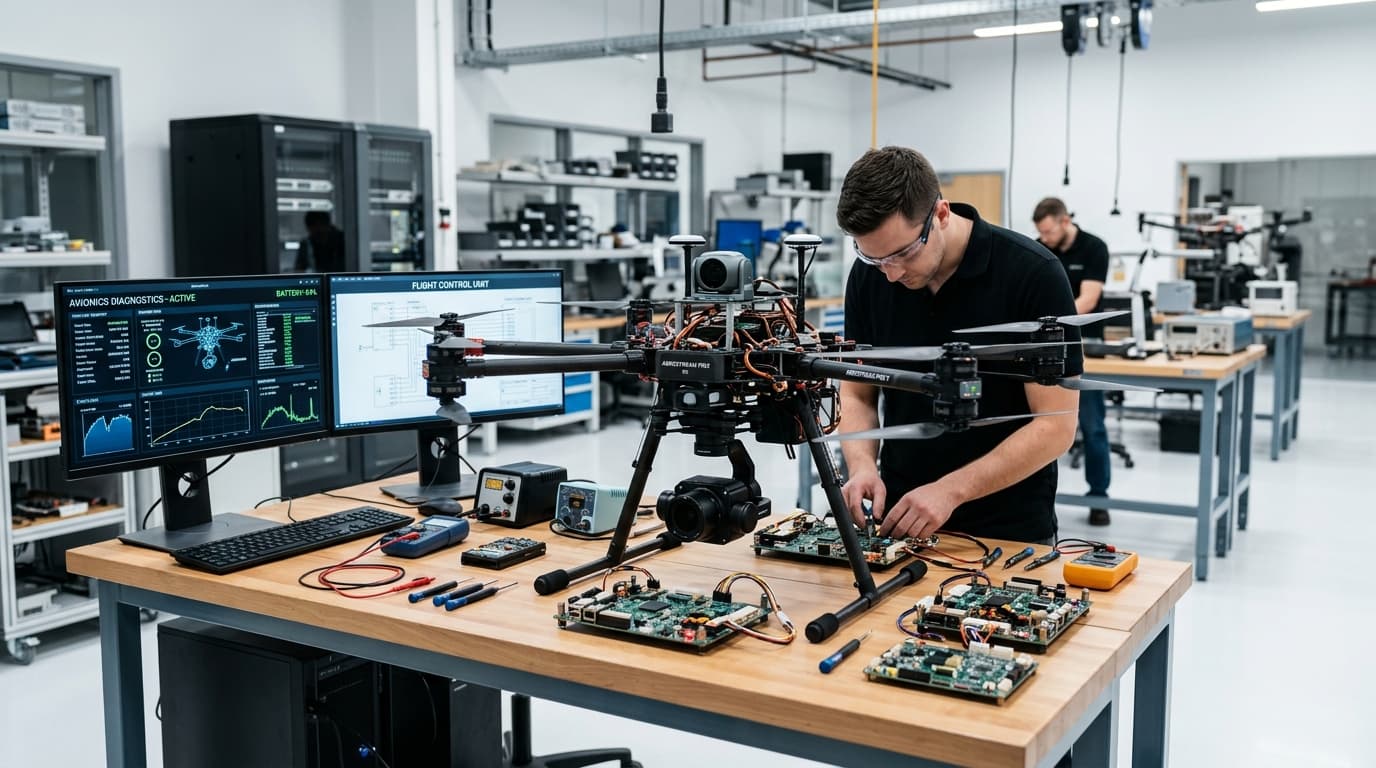
Custom PCB & Avionics Architecture: Designing specialized flight controller breakout boards, power distribution boards (PDBs), and sensor integration modules tailored to exact payload and mission specifications.
Rapid Hardware Iteration: Utilizing advanced inhouse manufacturing and rapid prototyping cells to test, refine, and iterate electronic layouts in days rather than months.
Environmental Stress Testing (EST): Subjecting prototype avionics to thermal cycling, vibration profiling, and electromagnetic compatibility (EMC) testing to guarantee performance under extreme field conditions.
FUTURE-PROOFING: MODULAR FRAMEWORKS AND EDGE-AI INTEGRATION
Tomorrow's commercial airspace will be fully autonomous, requiring drones to make realtime decisions onboard rather than relying solely on remote pilot inputs or latent cloud connections.
Wafi Engineering futureproofs your fleet by building scalable, modular drone frameworks designed for seamless edgeAI integration. By decoupling core flight control systems from auxiliary mission payloads, our architectures allow enterprises to hotswap or upgrade onboard neural processing units, computer vision cameras, and LiDAR arrays as software capabilities evolve.
READY TO BUILD SMARTER COMMERCIAL UAVS?
Whether you are scaling an industrial inspection fleet or designing a nextgeneration delivery drone, Wafi Engineering's Aerospace Division provides the specialized hardware engineering and avionics expertise needed to dominate your market. Contact us today to turn your UAV roadmap into a flightready reality.
Our approach blends custom hardware, system integration, and standard-compliant simulation methodologies. As technology continues to evolve, Wafi Engineering remains dedicated to delivering state-of-the-art engineering solutions that empower local industries and global partners to build cleaner, smarter, and more resilient systems for tomorrow.

Managing Director – Aerospace, Wafi Engineering
Experienced aerospace systems engineer managing high-fidelity CFD simulations and UAV prototyping lifecycles to deliver robust flight technologies.