The Role of Structural Finite Element Method (FEM) Analysis in Modern Lightweight Aerospace Manufacturing
Modern aerospace engineering demands advanced lightweight materials without compromising structural integrity, making highprecision FEM analysis indispensable.
The aerospace industry operates under a relentless paradox: every single gram shaved off an aircraft translates directly to fuel savings, extended range, and increased payload capacity, yet structural failure is never an option. As aerospace manufacturers race to adopt advanced composite materials, lithiumaluminum alloys, and additivemanufactured lattices, the margin for error narrows. Ensuring these lightweight structures can survive extreme operational environments requires moving beyond empirical guesswork into the realm of advanced Finite Element Method (FEM) structural analysis.
At Wafi Engineering's Aerospace Division, we provide cuttingedge finite element analysis consulting, helping engineering teams simulate, optimize, and validate aerospace components before physical manufacturing even begins.
THE WEIGHT-STRENGTH PARADOX: BALANCING MASS AND DURABILITY
The pursuit of netzero aviation and highefficiency commercial drones has permanently altered material selection. Traditional heavy metallic frameworks are rapidly being replaced by carbonfiberreinforced polymers (CFRPs), titanium honeycombs, and tailored metal matrix composites.
However, these modern materials behave anisotropically and nonlinearly under load. Unlike traditional isotropic metals, composites do not bend uniformly or deform predictably past their yield points. Predicting how a complex, multilayered composite skin handles multiaxial stress requires sophisticated numerical models that map stress distribution across every microscopic layer, ensuring maximum weight reduction without sacrificing ultimate structural strength.
DECODING FAILURE POINTS: LINEAR VS. NON-LINEAR FEM ANALYSIS
Aerospace components experience brutal operating conditions, from highfrequency engine vibrations and acoustic loading to severe thermal gradients during supersonic acceleration. Understanding how a structure responds requires a deep dive into its failure mechanisms:
Stress Concentrations: Identifying localized stress spikes around fastener holes, cutouts, and joint interfaces where structural geometry changes abruptly.
Fatigue and Crack Propagation: Simulating cyclic loading over thousands of flight hours to predict crack initiation and slow fatigue growth.
Thermal Distortion: Analyzing how extreme temperature swings, such as transitioning from subzero cruising altitudes to solar radiation exposure, cause differential thermal expansion and warping.
While linear FEM handles simple elastic deformations under static loads, nonlinear FEM analysis is essential for capturing large geometric displacements, plastic yielding, and contact friction during crash or extremeload scenarios.
WAFI CAPABILITY SHOWCASE: PRECISION FEM MODELING SUITES
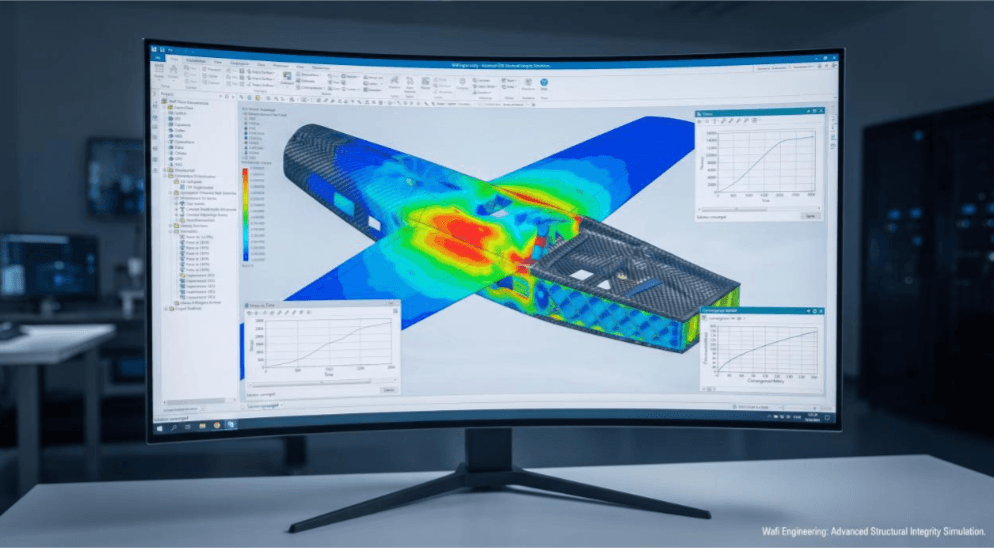
Wafi Engineering delivers comprehensive structural integrity simulation suites tailored to the rigorous demands of aerospace and UAV development. Our engineering capabilities give you complete visibility into your hardware's physical limits:
Advanced Load Case Simulation: We model complex multiaxial forces, gust loads, and inertial Gforces across entire aircraft assemblies and subcomponents.
Vibration and Modal Analysis: Pinpointing natural frequencies, harmonic responses, and resonance modes to prevent catastrophic structural flutter during flight.
Coupled Thermal-Structural Modeling: Evaluating how thermal expansion interacts with mechanical loads, ensuring components maintain dimensional stability and safety margins in harsh operational theaters.
COMPETITIVE ADVANTAGE: FAST-TRACKING INTERNATIONAL COMPLIANCE
Securing airworthiness certification from international regulatory bodies (such as the FAA or EASA) is often the most timeconsuming and capitalintensive phase of an aerospace program. Regulatory agencies demand exhaustive proof of structural safety under ultimate and limit load conditions.
Partnering with Wafi Engineering provides your program with the robust, auditready validation packages required to satisfy strict compliance standards faster. By replacing costly, protracted physical destructive testing cycles with highfidelity FEM validation, we help you eliminate redesign loops, reduce physical prototype waste, and accelerate your path to market.
READY TO VALIDATE YOUR NEXT AEROSPACE STRUCTURE?
Whether you are optimizing a lightweight drone composite frame or certifying a commercial aircraft component, Wafi Engineering's Aerospace Division offers the specialized FEM expertise and computational infrastructure to guarantee structural perfection. Contact our engineering team today to schedule an analysis consultation.
Our approach blends custom hardware, system integration, and standard-compliant simulation methodologies. As technology continues to evolve, Wafi Engineering remains dedicated to delivering state-of-the-art engineering solutions that empower local industries and global partners to build cleaner, smarter, and more resilient systems for tomorrow.

Managing Director – Aerospace, Wafi Engineering
Experienced aerospace systems engineer managing high-fidelity CFD simulations and UAV prototyping lifecycles to deliver robust flight technologies.