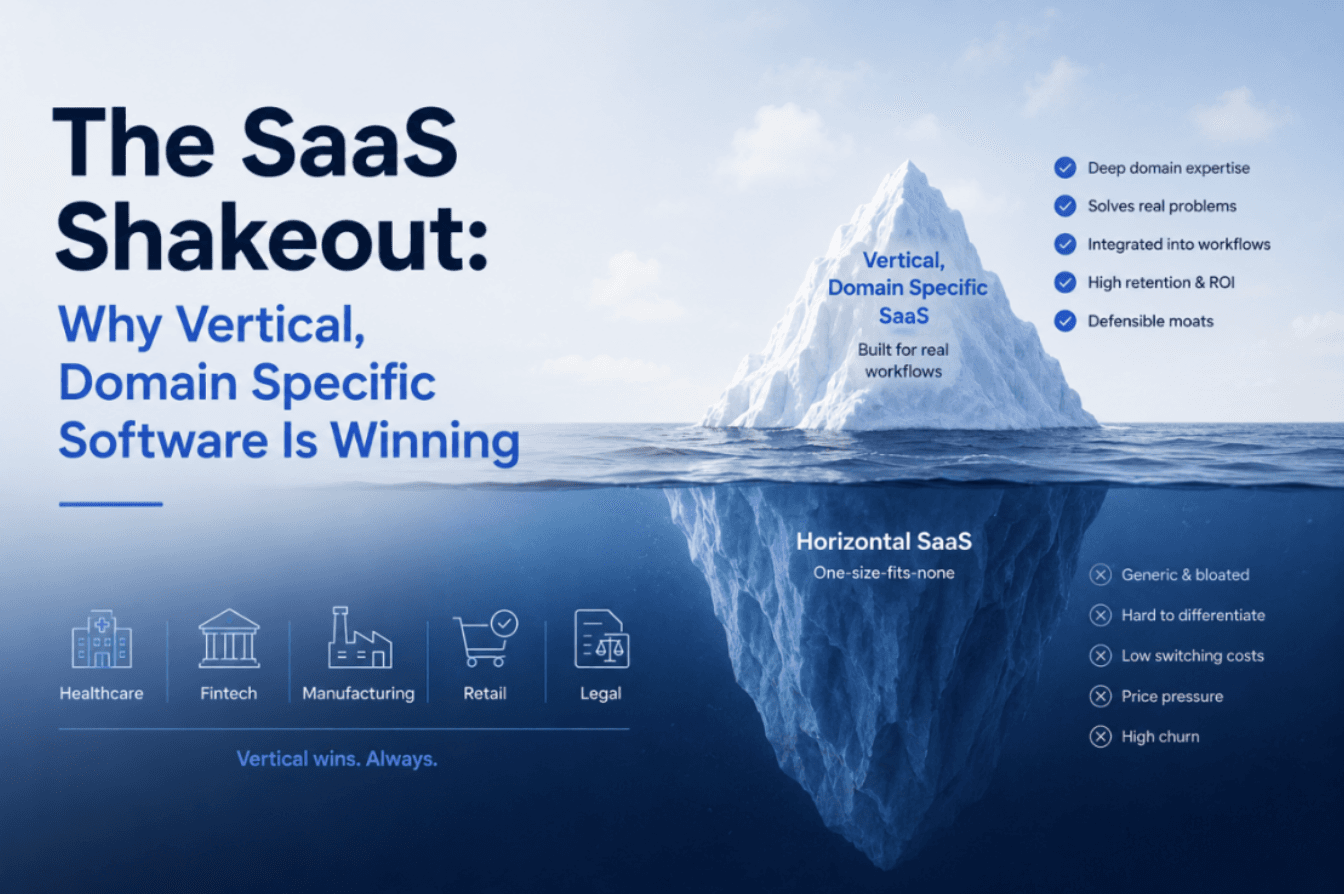
The SaaS Shakeout: Why Vertical, Domain Specific Software Is Winning
As point solutions face pricing pressure, deep domain-specific vertical SaaS platforms are capturing the enterprise market.
Software as a service had a rough reckoning in early 2026. Valuation multiples for public SaaS companies compressed sharply from their 2021 highs, and a wave of point solution tools, generic survey software, basic CRMs, simple task managers have come under real pressure as AI agents start handling what used to require a dedicated subscription.
But that contraction tells only half the story. While generic SaaS tools have struggled, vertical AI software built specifically for the workflows of one industry, with deep domain knowledge baked in rather than a thin customization layer over a generic platform has grown dramatically and is forecast to keep outpacing legacy vertical software by a wide margin.
The distinction matters for any business deciding whether to buy off the shelf software or commission something custom. A generic project management tool can track tasks for a textile exporter and a UAV manufacturer equally well, because it doesn't understand either business. A platform built specifically around, say, export documentation and customs compliance, or specifically around flight test data logging, can automate decisions a generic tool simply can't, because it actually encodes how that industry works.
This is the logic behind much of the custom software and ERP work Wafi Engineering builds for clients, a SaaS portal or ecommerce platform designed around a specific business's actual operations outperforms a generic template precisely because it doesn't force a company's workflow to bend around someone else's assumptions about what a 'standard' business looks like.
There's a second factor accelerating this shift: low code and no code platforms have matured enough that domain experts, people who deeply understand healthcare billing, or textile export logistics, or solar installation scheduling can now contribute directly to building the tools they use, rather than relying entirely on a separate technical team to translate their needs. That doesn't eliminate the need for skilled engineering; it changes where that engineering effort is best spent on the hard architectural and integration problems, while domain logic gets co designed with the people who actually live it daily.
For businesses evaluating software investment in this climate, the practical takeaway is to be skeptical of one size fits all platforms for anything central to how the business actually makes money and to treat custom, domain aware software not as a luxury, but as the more defensible long term bet.
Our approach blends custom hardware, system integration, and standard-compliant simulation methodologies. As technology continues to evolve, Wafi Engineering remains dedicated to delivering state-of-the-art engineering solutions that empower local industries and global partners to build cleaner, smarter, and more resilient systems for tomorrow.

Lead Web Developer & Designer, Wafi Engineering
Full-stack developer and designer focused on crafting high-performance modern web platforms and seamless user interfaces with premium interactive experiences.